
| constructsstudentfriendly-1.pdf |
All Kinds of Minds Constructs
#1 Memory:
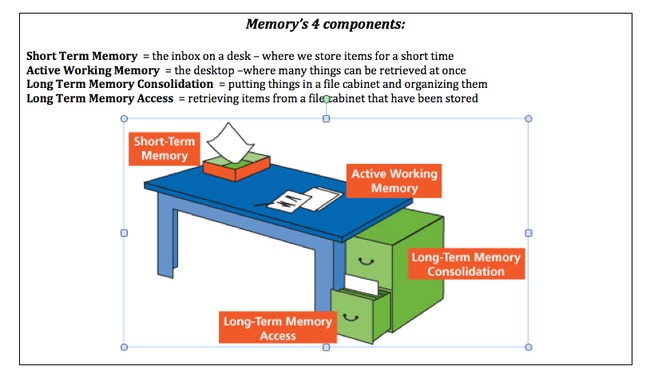
Definition: Briefly recording new information, mentally juggling information while using it to complete a task, and storing and then recalling information at a later time. Memory deals with the brain’s storage system. There is a difference between understanding and remembering. It is easier to remember than understand something.
Short Term Memory:
Stores small bits of information for brief durations – like an inbox on a desk. Information from short term memory can be used right away, stored for later use, or discarded
Students strong in short term memory may:
• copy from the board or screen efficiently, not needing to look up very often
• paraphrase or summarize easily
• readily follow instructions
Students who struggle with short term memory may:
• frequently have to look up when copying from a board or screen
• struggle with paraphrasing or summarizing
• get confused with instructions
Active Working Memory:
Organizes information and can manipulate it – like the desktop where several stacks may be made with different information. Active working memory helps a person manage and juggle multiple pieces of information at once.
Students strong in active working memory may:
• hold onto beginning of reading passage when reaching the end
• complete multi-step tasks and execute multi-step math procedures
• perform mental math calculations
• simultaneously handle the many tasks involved in writing (like spelling, punctuation, idea generation)
Students who struggle with active working memory may:
• forget information from beginning of reading passage when reaching the end
• lose track of multiple steps
• struggle with mental math calculations
• have trouble simultaneously juggling the many tasks involved in writing
Long-Term Memory Consolidation:
Stores information for later recall, like placing items in a file cabinet. The organization of how information is stored is important and effects the ability to recall information efficiently.
Students strong in long- term memory consolidation may:
• easily learn new terminology, facts, and procedures
• master sound-symbol associations for phonics
• recognize previously encountered patterns
• connect new material with prior knowledge
Students who struggle with long-term memory consolidation may:
• study by rote, rather than strategically (reads over and over, with no plan)
• have particular trouble with cumulative subjects (subjects that skills build upon each other)
• struggle to recall information, even when given recognition cues (like multiple choice options)
Long-Term Memory Access:
Retrieves information after a delay. This is like pulling information out of a file cabinet. Information takes many forms.
Students strong in long-term memory access may:
• retrieve one half of a pair when given the other half (such as definitions with terms, names with faces)
• recall proper procedure for the problem or situation
• perform well with free-recall (or open-ended) question
Students who struggle with long-term memory access may:
• be slow to recall facts
• use incorrect procedure for a problem or situation
• struggle with free-recall questions (but may perform better with recognition items if Long- Term Memory Consolidation is
functioning appropriately)
Stores small bits of information for brief durations – like an inbox on a desk. Information from short term memory can be used right away, stored for later use, or discarded
Students strong in short term memory may:
• copy from the board or screen efficiently, not needing to look up very often
• paraphrase or summarize easily
• readily follow instructions
Students who struggle with short term memory may:
• frequently have to look up when copying from a board or screen
• struggle with paraphrasing or summarizing
• get confused with instructions
Active Working Memory:
Organizes information and can manipulate it – like the desktop where several stacks may be made with different information. Active working memory helps a person manage and juggle multiple pieces of information at once.
Students strong in active working memory may:
• hold onto beginning of reading passage when reaching the end
• complete multi-step tasks and execute multi-step math procedures
• perform mental math calculations
• simultaneously handle the many tasks involved in writing (like spelling, punctuation, idea generation)
Students who struggle with active working memory may:
• forget information from beginning of reading passage when reaching the end
• lose track of multiple steps
• struggle with mental math calculations
• have trouble simultaneously juggling the many tasks involved in writing
Long-Term Memory Consolidation:
Stores information for later recall, like placing items in a file cabinet. The organization of how information is stored is important and effects the ability to recall information efficiently.
Students strong in long- term memory consolidation may:
• easily learn new terminology, facts, and procedures
• master sound-symbol associations for phonics
• recognize previously encountered patterns
• connect new material with prior knowledge
Students who struggle with long-term memory consolidation may:
• study by rote, rather than strategically (reads over and over, with no plan)
• have particular trouble with cumulative subjects (subjects that skills build upon each other)
• struggle to recall information, even when given recognition cues (like multiple choice options)
Long-Term Memory Access:
Retrieves information after a delay. This is like pulling information out of a file cabinet. Information takes many forms.
Students strong in long-term memory access may:
• retrieve one half of a pair when given the other half (such as definitions with terms, names with faces)
• recall proper procedure for the problem or situation
• perform well with free-recall (or open-ended) question
Students who struggle with long-term memory access may:
• be slow to recall facts
• use incorrect procedure for a problem or situation
• struggle with free-recall questions (but may perform better with recognition items if Long- Term Memory Consolidation is
functioning appropriately)
#2 Attention
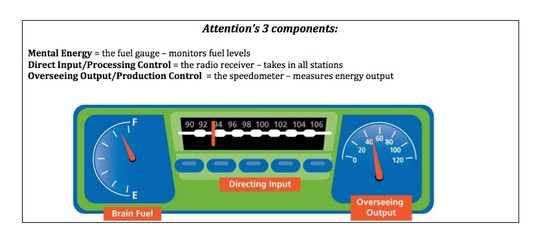
Definition: Attention has several jobs. It supplies fuel for thinking, working and learning, manages input from all the senses, and oversees all outputs involved in completing tasks (like academic tasks). Attention is the brain’s dashboard.
Mental Energy:
Maintains mental energy for learning and work and distributes a reliable flow of energy for tasks at hand. Allows for ability to sustain energy in order to be able to intake a constant flow of information.
Students strong in mental energy may:
• readily start working and maintain effort level
• actively engage when reading or listening
• appear to have sufficient and reliable energy when working
• get adequate sleep in terms of quantity and quality
Students who struggle with mental energy may:
• have trouble initiating and sticking with tasks
• do not seem alert when reading or listening
• appear excessively fatigued when working
• alertness and energy levels fluctuate
• fidget and seek physical stimulation to stay vigilant
• have trouble falling asleep (despite having a calming bedtime routine), staying asleep, and waking; may not be fully awake until
well into the school day
Processing Controls/Direct Input:
Absorbs and filters incoming information from all the senses, makes choices regarding more and less important inputs. Allows for focus with sufficient intensity and duration.
Students strong in processing controls may:
• resist the pull of distractions (such as sights and sounds)
• maintain focus for adequate stretches of time
• readily shift focus during transitions
• notice key details
• follow instructions with no need for repetition
• make appropriate connections between new information and prior knowledge
• concentrate during relatively unexciting activities
Students who struggle with processing controls may:
• lose focus relatively quickly; easily distracted
• be easily overwhelmed by detailed information
• have trouble shifting focus during transitions
• miss key details
• gloss over material too quickly to absorb it
• make unimportant connections between new information and prior knowledge
• have trouble concentrating during relatively unexciting activities
• seeks a great deal of stimulation, perhaps to the point of risk-taking
Production Controls/Overseeing Output
Oversees quality of academic output, previews likely outcomes for various scenarios and inhibits impulses.
Students strong in production controls may:
* resist impulses
* plan before starting tasks
* work at an appropriate pace
* notice and corrects mistakes
* use feedback from previous experiences to inform decisions
Students who struggle with production controls may:
• be susceptible to impulses
• jump into tasks without sufficient planning
• rush through work
• miss mistakes and opportunities to improve work quality
• have trouble using feedback from previous experiences to inform decisions
#3 Temporal-Sequential Ordering
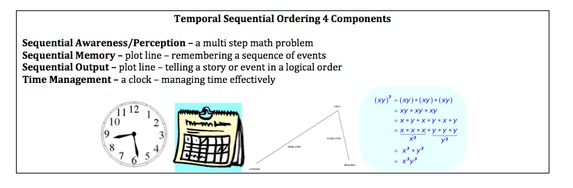
Definition: Understanding the order of steps, events or other sequences, generating products arranged in a meaningful order, organizing time and schedules
Sequential Awareness/Perception:
Awareness and processing of the order of the parts of incoming information.
Students strong in sequential awareness may:
• recognize multistep instructions and explanations as a sequence
• notice rhythm in a song or poem
• learn information where order is important (days of the week, months of the year, number lines)
• understand order of multiplication table or steps in a math process
• decode long, multi-syllabic words
Students who struggle with sequential awareness may:
• miss steps of sequential instructions
• have trouble with remembering sequence of lock combinations
• be unable to determine order of events in a story
• be unable to understand explanations given in a series of steps
Sequential Memory:
Remembering and maintaining the order of steps, events, or other sequences
Students strong in sequential memory may:
• follow sequential directions and complex explanations well
• recall new procedures without noticeable difficulty
Students who struggle with sequential memory may:
• require repetition of multiple step directions
• forget processes in mathematics
• have trouble storing and accessing non-motor sequences (adding fractions)
Sequential Output:
Creating products where the content is arranged in the optimal order
Students strong in sequential output may:
• tell stories in a logical, organized manner
• perform tasks using a logical step by step process
Students who struggle with sequential output may:
• confuse order of events when telling a story
• have difficulty producing non motor sequences ( balancing equations)
• have problem planning long term projects
Time Management:
Using time efficiently, including mapping out long term plans
Students strong in time management may:
• meet deadlines and stick with schedules
• know what to do and when to do it
• comprehend vocabulary dealing with time
Students who struggle with time management may:
• be consistently late
• not realize when running behind
• fail to complete assignments on time
• have trouble with long term assignments
• fail to plan time for studying (cram the night before a test)
Sequential Awareness/Perception:
Awareness and processing of the order of the parts of incoming information.
Students strong in sequential awareness may:
• recognize multistep instructions and explanations as a sequence
• notice rhythm in a song or poem
• learn information where order is important (days of the week, months of the year, number lines)
• understand order of multiplication table or steps in a math process
• decode long, multi-syllabic words
Students who struggle with sequential awareness may:
• miss steps of sequential instructions
• have trouble with remembering sequence of lock combinations
• be unable to determine order of events in a story
• be unable to understand explanations given in a series of steps
Sequential Memory:
Remembering and maintaining the order of steps, events, or other sequences
Students strong in sequential memory may:
• follow sequential directions and complex explanations well
• recall new procedures without noticeable difficulty
Students who struggle with sequential memory may:
• require repetition of multiple step directions
• forget processes in mathematics
• have trouble storing and accessing non-motor sequences (adding fractions)
Sequential Output:
Creating products where the content is arranged in the optimal order
Students strong in sequential output may:
• tell stories in a logical, organized manner
• perform tasks using a logical step by step process
Students who struggle with sequential output may:
• confuse order of events when telling a story
• have difficulty producing non motor sequences ( balancing equations)
• have problem planning long term projects
Time Management:
Using time efficiently, including mapping out long term plans
Students strong in time management may:
• meet deadlines and stick with schedules
• know what to do and when to do it
• comprehend vocabulary dealing with time
Students who struggle with time management may:
• be consistently late
• not realize when running behind
• fail to complete assignments on time
• have trouble with long term assignments
• fail to plan time for studying (cram the night before a test)
